
If you've been scrolling Facebook, Instagram or any of the major news sites over the past few weeks, you've almost certainly run into the same gadget we did: Jetterix.
A small brass attachment. Screws onto a garden hose, supposedly turns the hose into a pressure washer. Glowing reviews in every gardening group. Ads everywhere. A pile of emails from readers asking us whether any of it is real.
So we checked it out ourselves. Ordered a Jetterix and spent 14 days putting it through real-world tests around the house — without any deference to the marketing claims. Here's what we found.
Jetterix delivers surprisingly close to what the ads promise.
For the typical cleaning jobs around a home — patio, driveway, car, siding — it's noticeably more practical than a traditional pressure washer. No power cord, almost no weight, lives in a kitchen drawer instead of the basement. Here are the test results, step by step:
First hurdle: how reliable is the manufacturer? Jetterix is sold exclusively through the official manufacturer's site — not on Amazon, not at the hardware store. That immediately makes a lot of readers suspicious (it made us suspicious too).
We placed our order Tuesday at 2:32 PM. Payment options: PayPal or credit card. Order confirmation hit our inbox within 9 minutes. Shipping notification with USPS tracking number: the following morning. Delivered on Thursday — 2 business days after ordering.
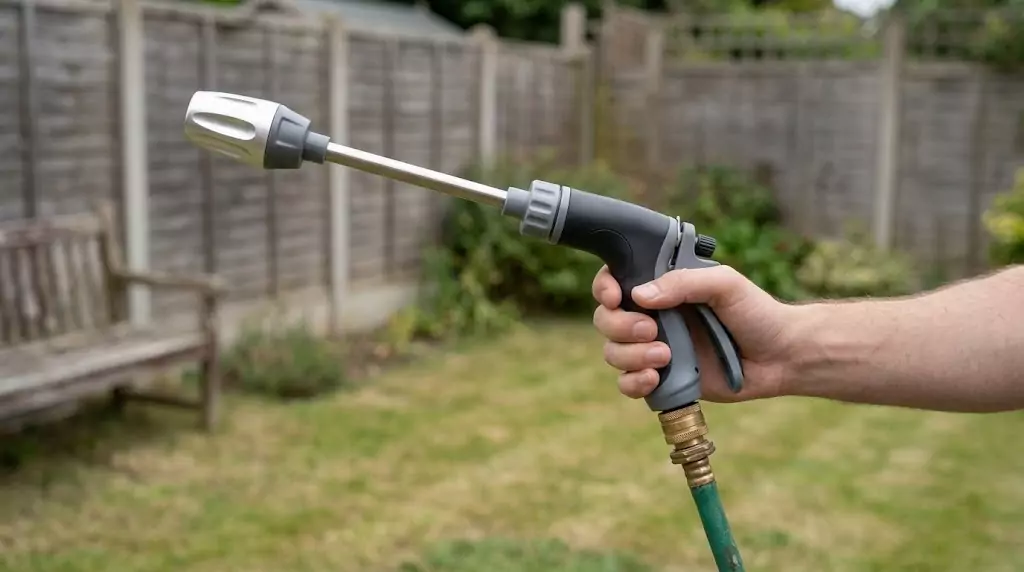
Packaging: solid. Printed cardboard box, foam-padded interior. Inside:
First impression: feels like real hardware, not a plastic toy. The brass is genuinely heavy compared to any hardware-store plastic nozzle. Thread machining is clean — no burrs, no sloppy edges. Installing it on the hose: unscrew the old spray head, screw Jetterix on. We timed it — 19 seconds, no tools.
Classic post-winter mess: the light stone pavers were coated in a grayish-green film, moss was creeping out of every joint, and several spots had black patches from rotting leaves. We'd deliberately left one corner alone over the winter to give us an honest test surface.
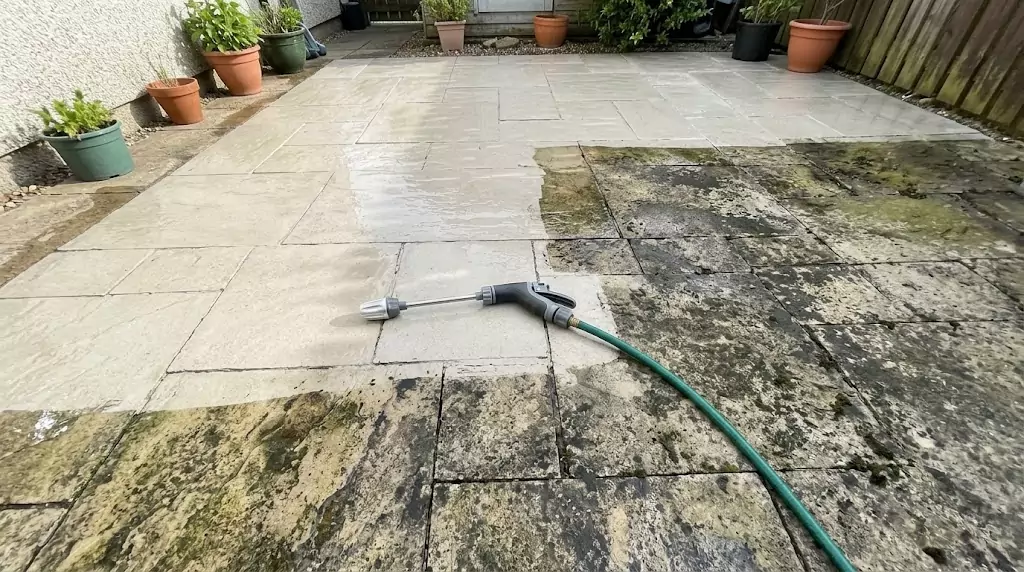
Set Jetterix to fan-spray, held it about 10 inches off the surface, swept it across the stones at a steady pace. For the stubborn black spots we switched briefly to focused jet — that was enough to lift the leaf stains in a single pass.
The biggest surprise: the moss joints. We'd photographed them out of skepticism, convinced you'd need a wire brush. We were wrong. The water jet blew the moss almost completely out of the joints, without damaging the joint sand itself.
One concern for anyone worried about spray: the fan setting is tight enough to work precisely — we didn't have to cover anything or move any furniture.
350 sq ft completely clean in 14 minutes. No brushing, no detergent, no kneeling. Stones bright again, joints clear. The biggest positive surprise of the test.
The harder test: a narrow concrete strip running along the side of the house between the wall and the tool shed. Little sun, lots of shade — perfect conditions for thick black algae growth. The surface was completely covered in a black-green coating — the concrete underneath wasn't even visible.
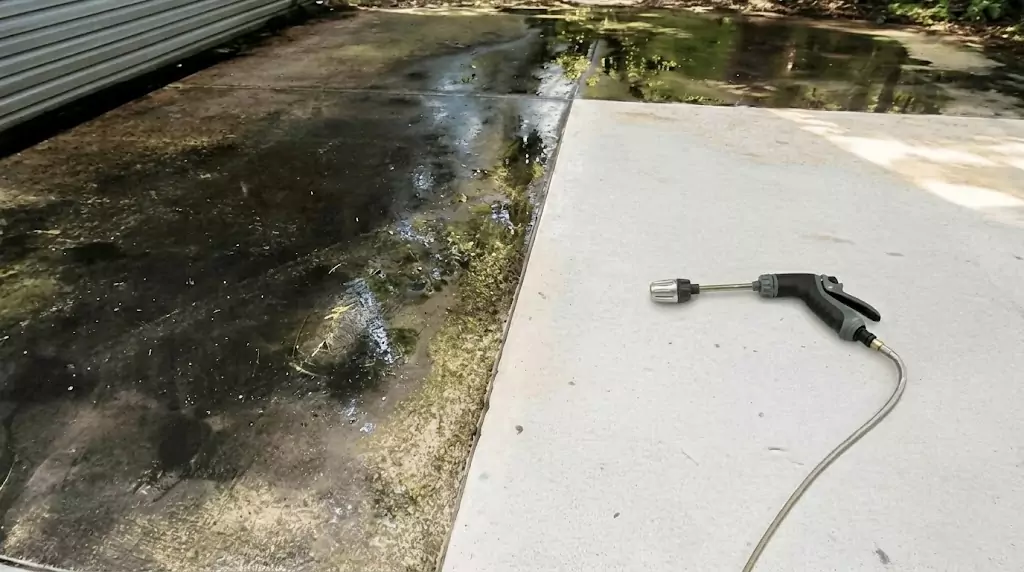
Here we wanted to know whether Jetterix could handle extreme buildup. Went straight to focused jet mode, worked it slowly in lanes. The black coating started lifting immediately — you could see it dissolving the moment the spray hit. It looked as though the layer was being peeled back in sections.
What honestly surprised us: even with this much buildup, a single pass was enough. And after 13 minutes of work, none of our testers felt tired — the nozzle weighs almost nothing, which is a real difference from a 25-pound wand.
200 sq ft from black-green to light gray in 13 minutes. A single pass was enough. Works just as well on years-old neglect as on light dirt.
The test we approached most carefully. Pressure washers and car paint are always a touchy combination — get too close and the paint takes a hit. Our tester's sedan was caked in road dust after a long highway run, with dried-on bug splatter across the hood and front bumper, and dark brake dust on the wheels.
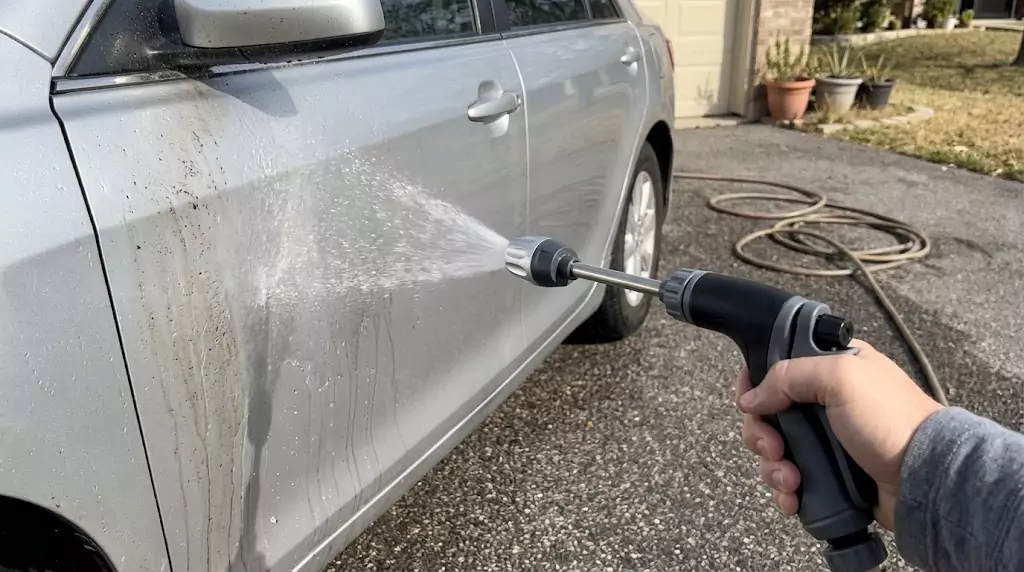
About 12 inches of distance, softest fan-spray setting. Hood and front first, then sides, then wheels. Bug residue came off completely on the second pass. Brake dust took about four or five minutes per wheel and then the wheel was actually clean.
The point most relevant for anyone protective of their paint: paint check after drying showed zero scratches, zero scuffs, no white marks anywhere. The chrome badge on the trunk lid wasn't dented, the plastic on the bumpers showed no marks.
Anyone who's tried this with a traditional gas or electric pressure washer knows the pit-of-stomach feeling. With the Jetterix, it's genuinely relaxed.
Whole exterior clean in 11 minutes. No bucket, no sponge, no car wash. Paint check afterwards: flawless.
During the 14-day test we also used Jetterix for a handful of jobs that came up naturally.
Quick summary:
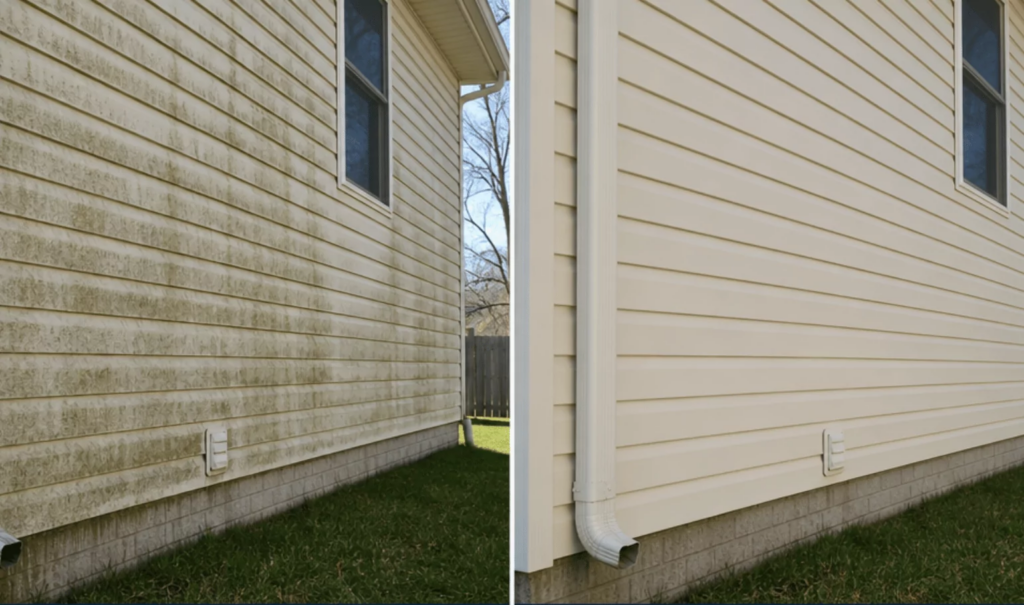
45 ft of lower siding with algae streaks — back to uniform beige in 12 minutes. Fan-spray, no need for focused mode.
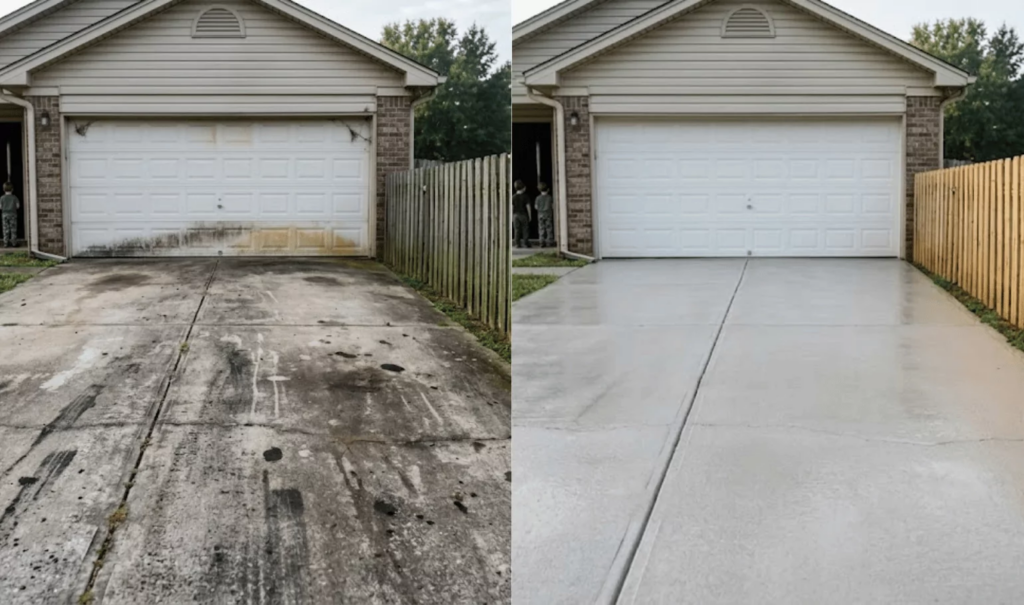
300 sq ft concrete drive with oil stains and tire marks. Focused jet, 14 minutes.
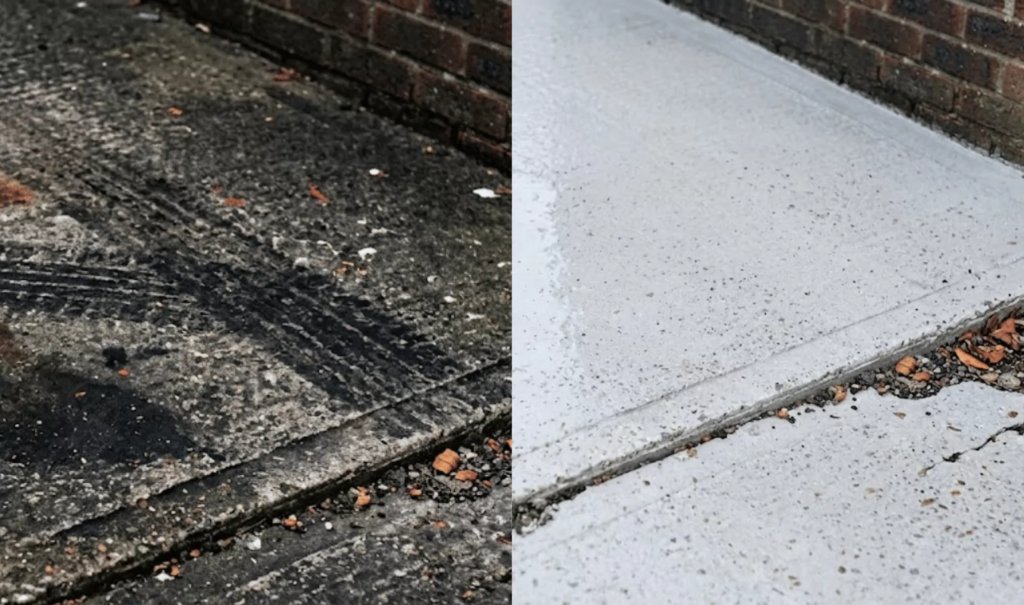
Small brick pavers at the garage entrance, darkly encrusted. Cleared in one pass.
At this point in the test we wanted to understand it. How can an attachment with no motor, no pump and no power produce the same kind of pressure as a 25-pound machine with a high-output pump?
The answer is the Venturi effect — an 18th-century discovery every engineer learns, but almost no garden-tool maker actually implements correctly. When water flows through a narrowing pipe, it accelerates. Same as when you put your thumb over the end of a garden hose — the jet suddenly shoots much farther.
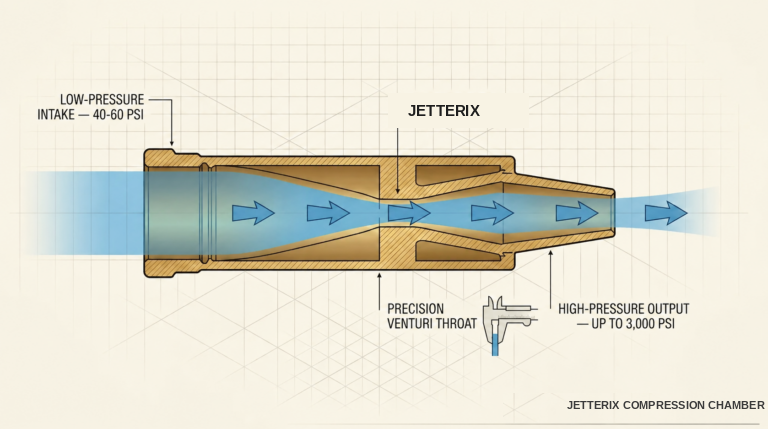
Jetterix builds this effect into three sequential chambers, each machined more precisely than the last:
Why no cheap plastic hardware-store nozzle pulls this off: First, the plastic can't handle the pressure and cracks within weeks. Second, the precision of the venturi throat is what makes the whole thing work — with tolerances over 0.02 inch, the effect disappears. The Jetterix is milled from solid brass, which holds the pressure long-term.
At a standard hose pressure of 60 PSI, the Jetterix produces an effective output of up to 3,000 PSI — comparable to a mid-range $350 pressure washer.
Not wanting to rely solely on our own test, we cross-checked the verified-buyer reviews across the major rating sites. The picture is consistent: over 7,000 verified reviews, an average of 4.7 out of 5 stars. The few negative reviews almost all revolve around delivery times during peak demand — not the product itself.
Says she sold her old $250 pressure washer within the same week — the Jetterix does the same job, but quieter, lighter, and without hauling a heavy machine up from the basement.
— Linda M., 64, verified buyer, Cleveland, OHAdmits she was skeptical after seeing so many ads, but tried it anyway and was won over — calls it exactly the right tool for a townhouse-sized yard.
— Mike S., 51, verified buyer, Tampa, FLHas arthritis and hasn't been able to manage a heavy pressure washer in years — says the lightweight nozzle let her clean her own walkway for the first time in a long time.
— Margaret F., 71, verified buyer, Phoenix, AZYes. The pack includes a full adapter kit for every common hose fitting — quick-connect, 1/2″, 5/8″, 3/4″ and 1″ standard threads. We tested three different hoses — all fit instantly. Even hoses from the 1990s work fine.
Unscrew your old spray head, screw Jetterix on. 20 seconds, no tools. If you can connect a garden hose, you can install the Jetterix.
No. The Jetterix has an adjustable nozzle — from soft fan-spray (for cars, wood, plants) to focused jet (for tough stains on stone or concrete). In our car test we saw zero paint damage.
Yes — the Venturi effect amplifies whatever pressure is there. Even homes with old plumbing and weak pressure (40 PSI) still get the high-pressure effect. At normal municipal pressure (60–90 PSI), you're well above any $300 pressure washer.
Neither. Jetterix is sold exclusively through the official manufacturer's website. There's a reason: cheap plastic knockoffs have already started appearing on Amazon and in hardware stores, using the brand name but containing zero brass — they crack within three weeks.
30 full days to try it out. Doesn't live up to the hype? Send it back. No phone calls, no explanation required, no retention emails trying to talk you out of it. Full refund, period.
The official manufacturer's site is running an introductory promotion with up to 60% off on every package. The promotion is time-limited — if you want to try it, don't wait too long.
Says this is the first review he's come across that actually put the product through real tests instead of repeating the ad copy — after six weeks of daily use, his own results match everything in the article, and his old pressure washer is now up for sale.
Like (214) · ReplyHad seen the ads everywhere and assumed it was the usual online gimmick, but the 30-day guarantee made it feel low-risk enough to try. Says her pavers look brand new, and she's since ordered two more for family.
Like (147) · ReplyA retired machinist who took the nozzle apart to check the brass claim himself — confirms it's genuine, with clean machining and precise threads, and calls it solid value for the price.
Like (98) · ReplyAsks whether the team also tried it on a car, since her regular pressure washer feels too aggressive for that job.
Like (12) · ReplyPoints her to the car test in the article, adding that he now prefers it over his old pressure washer for that job — the soft fan setting was gentle enough on the paint.
Like (38) · ReplyBought it as a birthday gift for her father, who used it to clean the entire driveway by himself the following weekend — she says she's never seen him so pleased with a gift.
Like (156) · ReplyHis wife's mildew-covered patio furniture came fully clean in about eight minutes after the box arrived — her reaction was that it was money well spent.
Like (71) · Reply